
About NCRETAC
How EMS Is Funded
Where the money comes from, where it goes, and why the gap between cost and revenue defines rural emergency care in Colorado.
The big picture
Colorado’s EMS System at a Glance
Before getting into the funding details, here is a system-wide view of who Colorado EMS serves, how it is funded, and what the data shows about patient outcomes and trauma response.
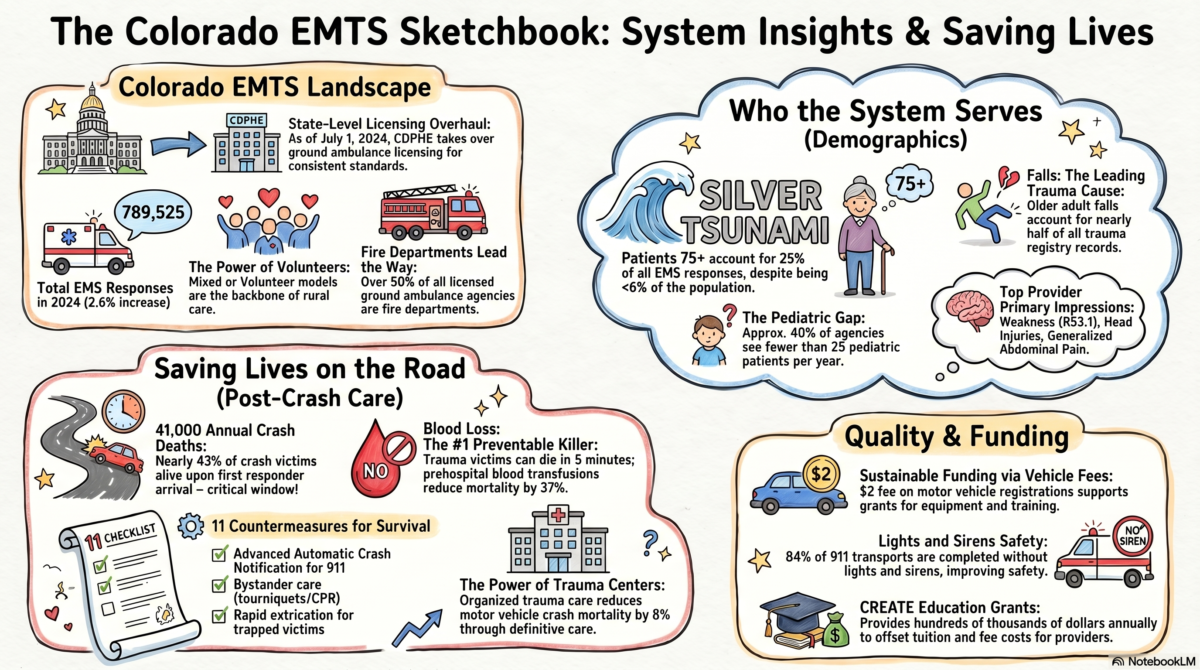
Source: Colorado EMTS Sketchbook: System Insights & Saving Lives. Click the image to open full size. Download infographic →
Start here
Four Things Most People Get Wrong
Most people assume an ambulance works like a fire truck — fully funded by local government, always staffed, always ready. That is not how it works in Colorado, and the gap between that assumption and reality has real consequences for rural communities across the region.
Your $2 registration fee funds regional coordination — not the ambulance or the crew
When you register your car in Colorado, $2 goes into a state account that funds regional coordination — training support, data systems, and the infrastructure that connects local agencies across the region. It does not pay for ambulances, fire trucks, stations, or the people staffing them 24 hours a day. That cost falls entirely on local funding: county mill levies, local taxes, and billing revenue. The $2 fee is the glue that holds the regional system together — it is not the system itself.
Agencies collect about 43 cents for every dollar they spend — and billing only starts when a call happens
Nationally, agencies collect roughly 43 cents of every dollar it costs to respond to a call. But billing only generates revenue when a call occurs. The cost of keeping a crew ready to respond 24 hours a day — whether calls come in or not — is not recoverable through insurance. Medicare covers about 35 percent of Colorado ambulance transports and sets the maximum rate all other insurers reference. The gap between cost and revenue is structural, not a sign of poor management.
Regional councils answer to counties, not to the state health department
Colorado is divided into 11 Regional Emergency Medical and Trauma Advisory Councils, known as RETACs. Each one is created by and answers to its county commissioners, not to the Colorado Department of Public Health and Environment. CDPHE provides funding to RETACs but does not direct them. NCRETAC serves nine counties in northeast Colorado.
The minimum funding for regional councils has not changed since 2000
Colorado law set the minimum annual funding for each regional council at $75,000, plus $15,000 per member county, in 2000. Those amounts have never been updated. Everything a regional council buys, and everyone it employs, costs significantly more than it did 25 years ago — but the baseline has not moved.
Where the money comes from
The Funding
~$12M/yr
State EMS Account
Funded by the $2 vehicle registration fee on approximately 6 million Colorado vehicles
~35%
Colorado EMS billed to Medicare
Medicare sets the payment ceiling that all other insurers use as a reference point
~43%
National EMS cost recovery rate
RAND / federal CMS research, 2025. Agencies collect roughly 43 cents per dollar of actual cost
Three separate money streams — and none of them fully covers the system
Colorado EMS runs on three funding streams that operate independently and cannot substitute for each other. The first is local infrastructure funding: mill levies, county appropriations, or local taxes that pay for the ambulances, fire trucks, stations, and personnel that have to be ready around the clock. No state, regional, or federal funding touches this. If your county levy is insufficient to cover readiness costs, the agency fills the gap through billing — or it does not fill it at all.
The second stream is health insurance billing: Medicare, Medicaid, and commercial insurers pay for individual transports after the call happens. This revenue helps offset operating costs but does not fund standby readiness. A crew sitting in a station at 2 a.m. waiting for a call generates no billable revenue. The cost of keeping that crew available is borne entirely by local funding — not by what they bill when someone finally calls.
The third stream is state infrastructure funding through the Highway User Tax Fund EMS Account — approximately $12 million per year statewide. This pays for regional coordination, training support, data systems, and agency grants. It does not pay for ambulances, stations, or personnel. Medicare sets the billing ceiling that all other insurers reference. Medicaid pays roughly 80 percent of the Medicare rate. Patients without insurance are effectively uncollectible — which for planning purposes means zero revenue.
How the state EMS account is divided
The $2 vehicle registration fee generates approximately $12 million per year for the state EMS account (formally the Highway User Tax Fund EMS Account). Colorado law divides that money three ways: grants to local ambulance agencies and trauma providers; funding for the 11 regional councils and their member counties, with legal minimums of $75,000 per council and $15,000 per county; and the state health department’s costs to license agencies and manage data.
Those legal minimums were written into law in 2000 and have never been updated. In real terms, regional councils are running on 25-year-old funding levels while their actual costs have risen substantially.
How EMS funding flows in Colorado
The state EMS account (~$12M/yr) is a dedicated sub-account separate from the general highway fund transportation distribution. Spending categories are set in Colorado law (CRS 25-3.5-603).
Who decides where the money goes
The Governance
Funding decisions in Colorado EMS flow through a layered governance structure. Understanding who controls each level explains why funding reform requires legislative action — not just administrative decisions — and why regional councils occupy a distinct position in that structure.
The federal government sets what Medicare and Medicaid pay. The state legislature controls the budget and passes EMS laws. A Governor-appointed advisory council called SEMTAC must approve those rules before they take effect. CDPHE licenses agencies and distributes funds. Regional councils coordinate the system in each region and answer to county commissioners. Local ambulance agencies respond to calls — funded by local mill levies and billing, not by state or regional infrastructure funding. Each of these layers has a defined role. None can substitute for another, and no funding from one layer flows down to cover the costs of the layer below it.
Colorado EMS Governance Structure
The dotted line between the regional council and CDPHE represents a funding relationship only, not authority or supervision. Regional councils are established by and accountable to county commissioners under Colorado law (CRS 25-3.5-704).
CDPHE
Colorado Department of Public Health and Environment
The state health department licenses ambulance agencies, certifies paramedics and EMTs, designates trauma centers, and distributes the state EMS account funds. These are regulatory duties assigned to a state agency by law. CDPHE provides funding to RETACs — it does not govern them.
SEMTAC
State Emergency Medical and Trauma Advisory Council
A 32-member advisory council appointed by the Governor, required by law to include equal urban and rural representation and to be bipartisan. SEMTAC must approve any new EMS rules before the State Board of Health can adopt them. That approval is a legal requirement, not a formality. It is the rural system’s structural protection against rules written without rural context.
RETACs
Regional Emergency Medical and Trauma Advisory Councils
Colorado’s 11 regional councils are created by and accountable to county commissioners under state law (CRS 25-3.5-704). They are not branches of CDPHE. The state health department provides funding to RETACs — that is the extent of its authority over them. NCRETAC is the regional council for northeast Colorado, serving nine counties.
SEMTAC and EMPAC are not the same body
Colorado law also designates a separate body called EMPAC (Emergency Medical Practice Advisory Council) as a Type 2 advisory entity. EMPAC advises only on the clinical scope of practice: what paramedics and EMTs are authorized to do medically. It has no role in system governance, funding, or rulemaking. SEMTAC is different: its approval is required by law before EMS rules take effect.
Take action
Get Involved
The EMS system in your community depends on regional coordination and informed local leadership. Here is where to start depending on your role.
EMS providers and agency directors
Share this page with your county commissioner. They govern your regional council and hold seats on SEMTAC. The more they understand the funding and governance structure, the more effectively they can represent your region.
County commissioners and elected officials
Contact NCRETAC directly. Your region’s Executive Director can walk you through how the funding flows to your counties and how your appointment authority shapes the regional council that serves your communities.
Everyone
Sign up for NCRETAC updates to stay informed as funding and policy decisions develop. The advocacy page tracks current legislative activity as it happens.
Sources
Phase IV Revenue Section 3: NCRETAC Funding Workgroup, April 2026
Colorado EMS cost and revenue analysis. Internal NCRETAC document.
RAND Corporation: Ground Ambulance Data Collection System Year 1-4 Cohort Analysis, August 2025
Prepared for the federal Centers for Medicare and Medicaid Services. National ground ambulance cost and revenue data. rand.org
Colorado TOPS Expense Report: CDPHE Health Facilities & EMS Division, January 2025 through March 2026
State EMS Account spending detail by category.
Colorado All Payer Claims Database / CIVHC FY25 Ambulance Analysis
Commercial insurance ambulance cost data, service dates 2018 through 2023.
HCPF Schedule 00, FY2026-27 Governor Budget Request
Colorado Medicaid budget totals and funding sources.
Colorado Revised Statutes — leg.colorado.gov
CRS 25-3.5-603 through 606 (state EMS account, spending categories, SEMTAC requirements) · CRS 25-3.5-704 (regional council establishment) · CRS 25-3.5-104 (SEMTAC composition and rule-approval authority) · CRS 25-3.5-206 (EMPAC designation)
Learn More About NCRETAC
NCRETAC is the Regional Emergency Medical and Trauma Advisory Council serving nine counties in northeast Colorado. We are funded through the state EMS account and governed by county commissioners across the region.
Page content reflects publicly available statutory, regulatory, and financial information. Statistics are sourced as noted above. This page does not constitute legal or financial advice. For current legislative activity, visit leg.colorado.gov.